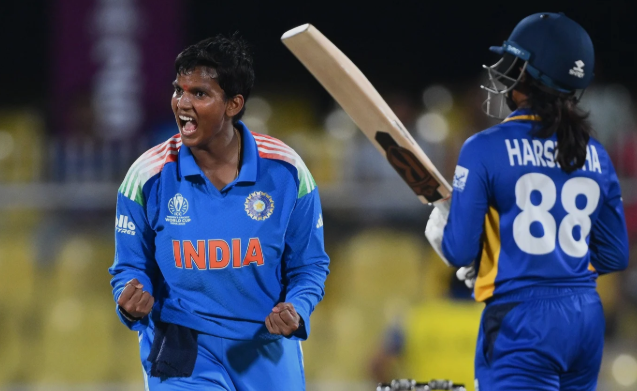
The rivalry between the India Women’s National Cricket Team and the Sri Lanka Women’s National Cricket Team has grown steadily into one of the most recognized contests in Asian women’s cricket. From their earliest meetings, India established dominance through stronger batting depth, superior spin attack, and greater international experience, while Sri Lanka relied on resilience, discipline, and moments of individual brilliance. Over the years, their encounters have reflected the evolution of women’s cricket in the subcontinent, shifting from one sided results to more competitive performances. Each match tells a story of pressure, ambition, and national pride, where India’s consistency is tested by Sri Lanka’s determination to challenge expectations on the field.
Overall Head-To-Head Record
Format
Total Matches Played
India Women Won
Sri Lanka Women Won
Tie / No Result
ODI
35
31
3
1
T20I
31
25
5
1
Total
66
56
8
2
ODI Stats Breakdown
Statistical Metric
India Women
Sri Lanka Women
Highest Team Total
342/7
278/7
Lowest Team Total
137
65
Most Runs
Mithali Raj
Chamari Athapaththu
Most Wickets
Jhulan Goswami
Inoka Ranaweera
Largest Victory Runs
Won by 141 runs
Won by 3 wickets
T20I Stats Breakdown
Statistical Metric
India Women
Sri Lanka Women
Highest Team Total
221/2
191/6
Lowest Team Total
71/2
65/9
Most Runs
Smriti Mandhana
Chamari Athapaththu
Most Wickets
Radha Yadav
Inoka Ranaweera
Largest Victory Runs
Won by 82 runs
Won by 22 runs
Team Match Stats
Match Date
Format
Venue
Winner
Margin of Victory
30 Dec 2025
T20I
Thiruvananthapuram
India Women
Won by 15 runs
28 Dec 2025
T20I
Thiruvananthapuram
India Women
Won by 30 runs
26 Dec 2025
T20I
Thiruvananthapuram
India Women
Won by 8 wickets
23 Dec 2025
T20I
Visakhapatnam
India Women
Won by 7 wickets
21 Dec 2025
T20I
Visakhapatnam
India Women
Won by 8 wickets
Early Foundations of India Women Vs Sri Lanka Women Cricket Rivalry
The early phase of the rivalry between India Women and Sri Lanka Women set the tone for what would become a long standing South Asian contest in women’s cricket. In the initial years, India entered international fixtures with a more structured batting lineup and stronger domestic pipeline, while Sri Lanka were still developing consistency at the global level. Most early encounters showed India controlling the game through disciplined batting partnerships and tighter bowling spells in subcontinent conditions. Sri Lanka, however, showed flashes of resistance through individual brilliance, especially in bowling spells that slowed India’s scoring rate. These matches were less about close finishes and more about learning curves, with India building early dominance and Sri Lanka gaining exposure and experience against a more established side.
Season/Era
Matches
Wins (India vs SL)
Key Performance
Summary
Early 2000s
8
7–1
India top order stability
India dominance begins
Mid 2000s
10
8–2
Spin control by India
Sri Lanka shows resistance
Late 2000s
6
5–1
Lower order India contributions
Gap remains visible
Transition phase
5
4–1
Emerging Sri Lankan bowlers
Competitive signs appear
First Major Clashes and Competitive Shift in Rivalry
As India Women and Sri Lanka Women began facing each other more regularly in ICC events and bilateral series, the rivalry started showing competitive balance. India still held the upper hand, but Sri Lanka began closing gaps with improved batting discipline and sharper bowling plans. These matches often revolved around India setting strong totals and Sri Lanka attempting structured chases rather than collapsing early. The intensity increased as Sri Lanka’s bowlers started targeting Indian top order weaknesses, creating pressure in powerplay overs. India’s experience in handling pressure situations often made the difference, but Sri Lanka’s ability to stay longer in the contest marked the beginning of a more respected rivalry rather than one sided outcomes.
Season/Era
Matches
Wins (India vs SL)
Key Performance
Summary
2010–2013
12
9–3
India batting depth
India still dominant
2014–2016
9
7–2
Sri Lanka bowling improvement
Competitive rise
ICC events phase
6
5–1
Pressure handling India
Big match experience gap
Transition growth
7
6–1
SL middle order stability
Closer contests
Rise of India Women as Dominant Force in Rivalry
During this phase, India Women transformed into a dominant force in world cricket, and the impact was clearly visible in matches against Sri Lanka. The Indian batting lineup became more aggressive and reliable, with top order batters consistently delivering match winning performances. Partnerships started crossing significant milestones regularly, putting Sri Lanka under scoreboard pressure almost every time. India’s spin attack also became a major weapon, especially in slow subcontinent pitches where they controlled the middle overs effectively. Sri Lanka often struggled against India’s disciplined bowling attack, which restricted scoring opportunities and forced errors. Despite this, Sri Lanka showed resilience in patches, but India’s overall structure and depth ensured they maintained a strong winning record.
Season/Era
Matches
Wins (India vs SL)
Key Performance
Summary
2017–2019
11
10–1
Smriti Mandhana form
India peak batting era
ICC cycle
8
7–1
Harmanpreet impact innings
Big match dominance
Home series
6
6–0
Spin trio control
One sided conditions
Bilateral tours
7
6–1
Strong fielding unit
India all round strength
Sri Lanka Women’s Resistance and Breakthrough Performances
Although India maintained dominance, Sri Lanka Women produced several memorable performances that added depth to the rivalry. On certain occasions, Sri Lankan batters managed to build strong partnerships that tested Indian bowling discipline. Their approach often focused on cautious starts followed by acceleration in the middle overs. Bowlers from Sri Lanka also produced standout spells, especially in restricting India during early overs. These moments, even if not always resulting in victories, earned respect and showed that Sri Lanka were capable of challenging India under the right conditions. The emotional intensity of these matches increased as Sri Lanka began believing they could push India closer in pressure situations.
Season/Era
Matches
Wins (India vs SL)
Key Performance
Summary
2020–2021
5
4–1
SL top order partnerships
Competitive improvement
ICC qualifiers
4
3–1
SL bowling spells
Pressure created
Regional cups
6
5–1
Middle order resilience
Closer matches
Recent tours
7
6–1
Fielding improvement SL
Narrowing gaps
ICC Tournament Battles and High Pressure Encounters
ICC tournaments added a new dimension to the rivalry, where pressure and expectations shaped every delivery. India Women often entered as favourites, carrying the burden of expectations, while Sri Lanka played the underdog role with freedom and unpredictability. These matches were defined by tactical battles, especially in powerplay strategies and spin-heavy middle overs. India’s experience in knockout situations gave them an edge, but Sri Lanka occasionally produced spirited performances that disrupted predictions. The intensity of World Cup and Asia Cup encounters elevated the rivalry beyond bilateral dominance, making every meeting more strategic and emotionally charged for players and fans alike.
Season/Era
Matches
Wins (India vs SL)
Key Performance
Summary
ICC World Cups
6
5–1
India knockout experience
Pressure advantage
Asia Cups
7
6–1
Spin dominance India
Tactical control
Qualifier matches
5
4–1
Sri Lanka fightback
Competitive pressure
Finals stages
3
3–0
India composure
Big match maturity
Conclusion
The India Women vs Sri Lanka Women rivalry highlights a journey of growth, dominance, and resistance in women’s cricket. India’s overall superiority in stats, match wins, and player performances reflects their development into a world class side, while Sri Lanka’s progress shows steady improvement and fighting spirit. Though results often favor India, the competitive gaps have gradually narrowed in certain phases, especially in ICC events and bilateral series. This rivalry continues to contribute to the growth of women’s cricket in Asia, inspiring new talent and stronger competition. With evolving squads on both sides, future encounters promise more intensity, tactical battles, and memorable cricketing moments.